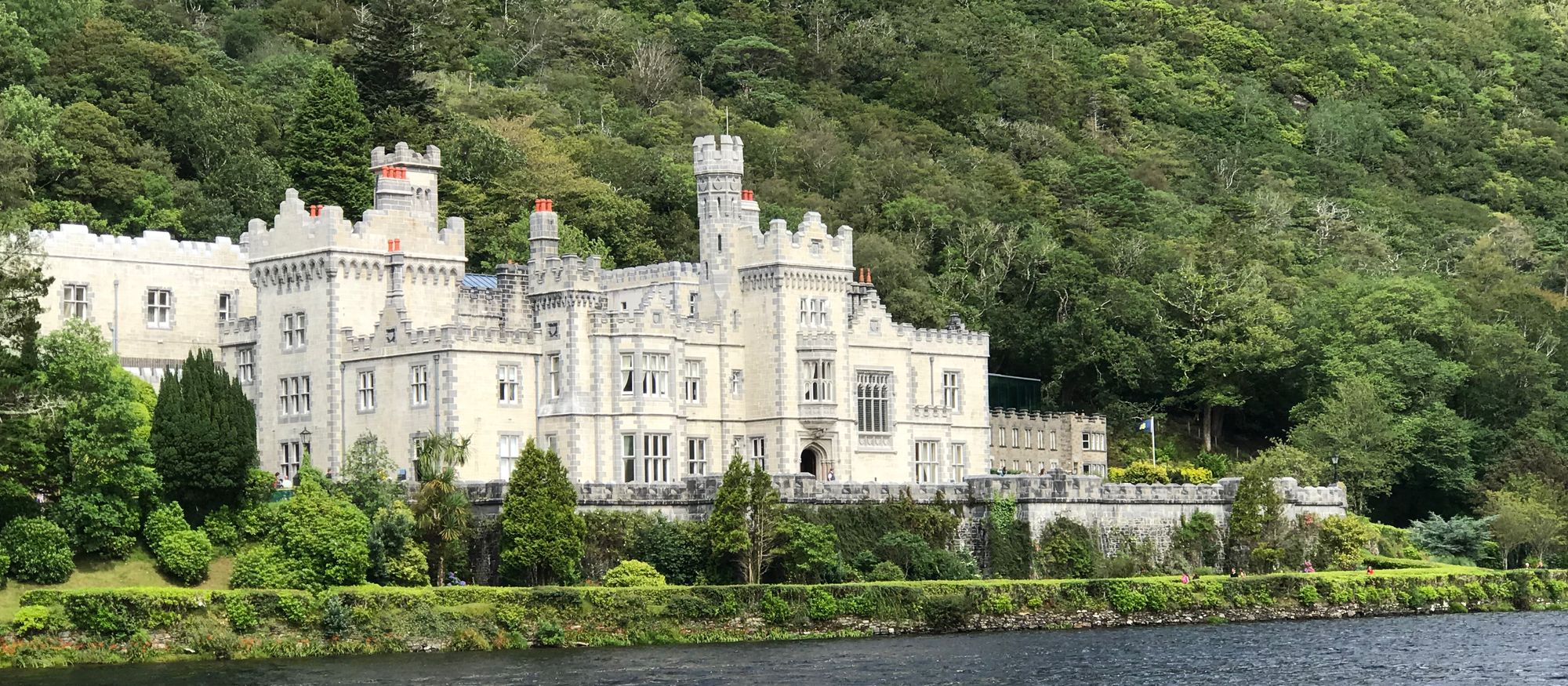
Landmark · Co. Galway

Ballynahinch Castle

The 1754 country house on Ballynahinch Lake, directly overlooked by Benlettery of the Twelve Bens — home once to Richard Martin, “Humanity Dick”, founder of the Society for the Prevention of Cruelty to Animals, now a hotel in a private estate.

The castle

Ballynahinch Castle is a former Irish country house and estate, built on the site of a former castle, which is now a luxury hotel set in a private estate in the Connemara region of County Galway, Ireland. The castle lies on the edge of Ballynahinch Lake and the Ballynahinch River, and it is directly overlooked by Benlettery, 557 metres, one of the Twelve Bens mountain range. That is the view the castle is known for: the lake in front, the river through the grounds, and the quartzite peaks standing straight up out of the water behind — the walk around the lake is the walk that takes in all of it.

The house and its history

The detached three-storey country house was built in 1754, and while the structure has been modified throughout its life, the castle still retains its architectural integrity. The estate country around it — the lake, the river and the grounds — is the place that visitors come for, and the walk from the castle down to the water and back is the walk that gets done.

The residents

One of the former residents of Ballynahinch Castle was Richard Martin, known as “Humanity Dick” (1754–1834), founder of the Society for the Prevention of Cruelty to Animals and Member of Parliament for County Galway — the man the SPCA is named after, who lived in the castle. Another owner was the Maharaja Jam Sahib, the Indian prince who owned the estate in the 20th century and the reason the castle's story runs from the Irish country house to the colonial era and back. The residents are the castle's second history: the MP, the prince, and the hotel that keeps the house standing today.

Practical

Ballynahinch Castle is in the Connemara region of County Galway, a drive from Galway city and Clifden; the lake and the river are at the castle's edge, and Benlettery is the peak in the view. The hotel and the estate have their own arrangements — confirm the current visiting, dining and stay options before travelling.

Sources and verification

🧭 Get directions

Where to stay

Stay under the Twelve Bens

The castle puts the lake, the river and Benlettery all in one view — the estate is the point.

  • Ballynahinch CastleThe estate itself — the hotel at the edge of the lake, under the peaks. · at the castle
  • ClifdenThe capital of the region, a drive to the west — the bigger base for Connemara. · 25 min by car
See stays at Ballynahinch Castle ↗

See current availability for your dates. Availability and prices come from the accommodation provider, not from us.

More in Galway

Kylemore Abbey reflected in Pollacapall Lough, County Galway
Attraction · Co. Galway

Kylemore Abbey

A castle turned abbey on the shore of Kylemore Lough in Connemara, three kilometres from Letterfrack in Co. Galway — one of the most photographed buildings in the west of Ireland, with a story that goes back to the 1860s.

Gardens and castle ticketed; the abbey grounds are free to view from the shore.· Allow 2–3 hours
Village · Co. Galway

Athenry

“Town of the ford of the king” — the medieval town on the River Clare, 25 km east of Galway, with the town wall, the castle, the priory, the 13th-century street-plan and the song that made its fields famous.

The town is free to visit. The castle and the priory may charge entry — confirm the current prices and opening hours before travelling.
Village · Co. Galway

Carna

The Gaeltacht focal point of west Connemara — a Garda station, the lifeboat, the health centre and the university's Irish-language centre, at the edge of the bog country 74 km west of Galway.

The area is free to visit. The research stations may have their own visiting arrangements — confirm before the visit. No admission for the coast and the bog country.
Village · Co. Galway

Cleggan

“The headland” — the fishing village at the head of Cleggan Bay, 10 km from Clifden, with the pier that Alexander Nimmo built in 1822 and the daily ferries to Inishbofin and Inishturk.

The village is free to visit. The island ferries carry their own fares — confirm the current schedules and prices before travelling.