Walks & Trails · Co. Donegal
Sample — Sold-out Cliff-top Photography Workshop (test data)
Monday 16 November 2026, 09:00
Headland · Co. Donegal
A wall of grey limestone dropping roughly 600 metres into the Atlantic on the Inishowen Peninsula — among the highest sea cliffs in Europe, and only properly seen from the foot of them.
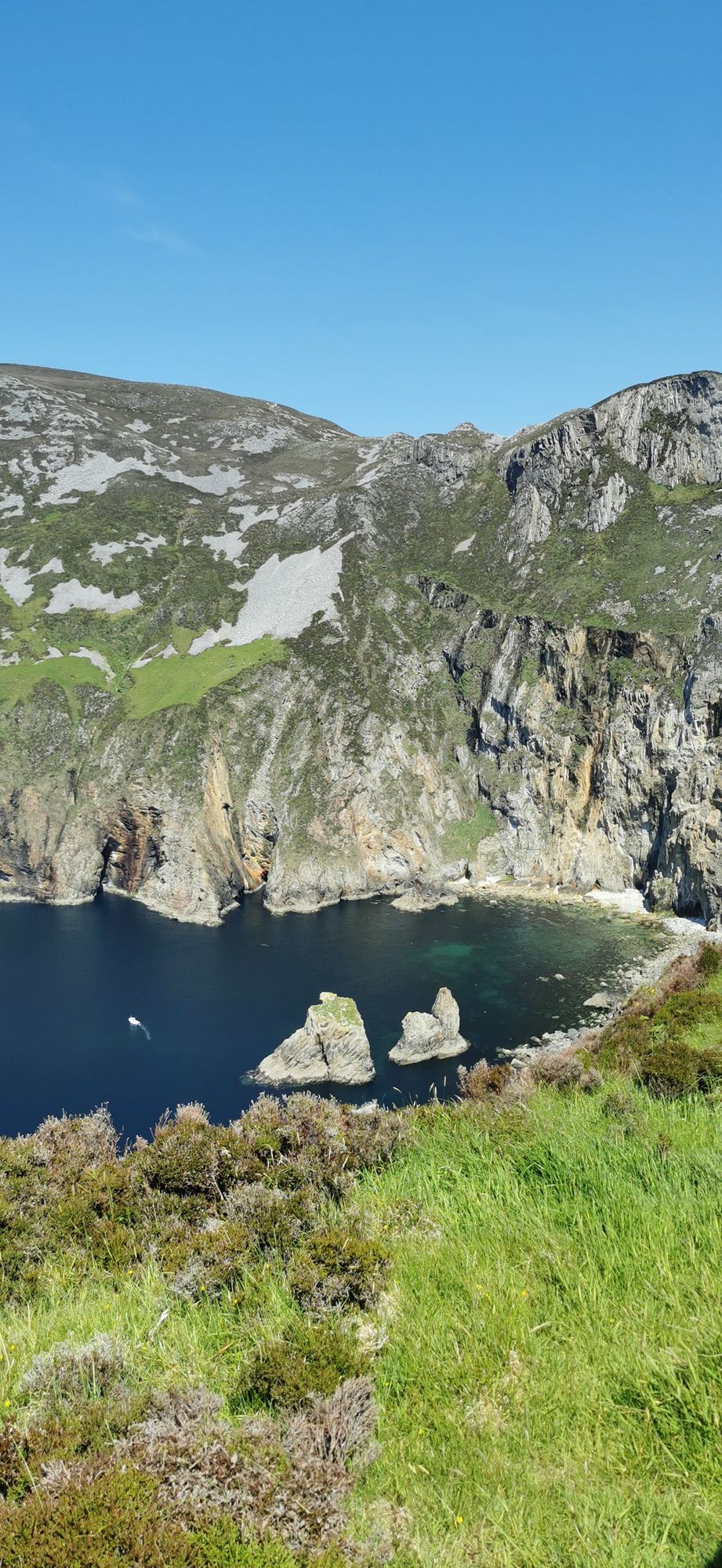
Slieve League is the kind of place where the map understates the thing. From the road, the headland reads as an ordinary stretch of cliff; from the car park up on the hill, it becomes a wall of grey limestone rising in a series of terraces, and from the foot of the cliffs — which you can only reach on foot — it becomes a vertical drop of around 600 metres into the open Atlantic. That height puts it among the highest sea cliffs in Europe, and one of the few places on the west coast where the full scale of the land meeting the sea is something you feel in your legs.
The name is a worn-down form of an older Irish one, and its meaning is genuinely disputed rather than settled, which is more honest than the confident etymologies you will find elsewhere. For centuries the headland was the seat of the O'Keeffe (Ó Cinnéide) family, and their story is woven into the place.
There is no road to the cliff face. The car park sits up on the hill above the village of Meenaleck, and from there a rough, steep path descends to the base of the cliffs. It is a walk of about two hours there and back, over uneven ground, and the final stretch close to the cliff base is exposed and can be wet and slippery. It is not a walk for anyone with a fear of heights, and it is the walk that makes the place — the first view of the cliff from below is one of the best in Ireland.
If the weather is against you, the cliff-top path from the car park is a gentler, if less dramatic, option and still gives a strong sense of the scale.
The Atlantic decides the weather here. Summer afternoons can bring a thick sea fog that closes the view to a few metres, and gales arrive without warning in any month. The light in the late afternoon in spring and early autumn is the best, and the cliff is at its most atmospheric in a slow, low winter gale.
Gannets, razorbills and a variety of other seabirds use the cliffs, and the foot of the cliff is a good place to watch them come in. Keep your distance and your dog on a lead; the birds are far more interesting than any photo you could get closer.
Free to visit; a small parking charge may apply at the car park. Allow two to three hours including the walk. There are no facilities at the cliff itself — the village of Meenaleck and the town of Rathmullan are the nearest places to eat and fuel up.
Monday 16 November 2026, 09:00
A large, remote mountain and glen country in southwest Donegal, centred on Derryveagh National Park — one of the wildest areas of lowland and mountain on the west coast.
The northwestern tip of mainland Ireland, where the Wild Atlantic Way starts — a lighthouse, a tenth-century cross, and the widest view of two seas you will get on this coast.