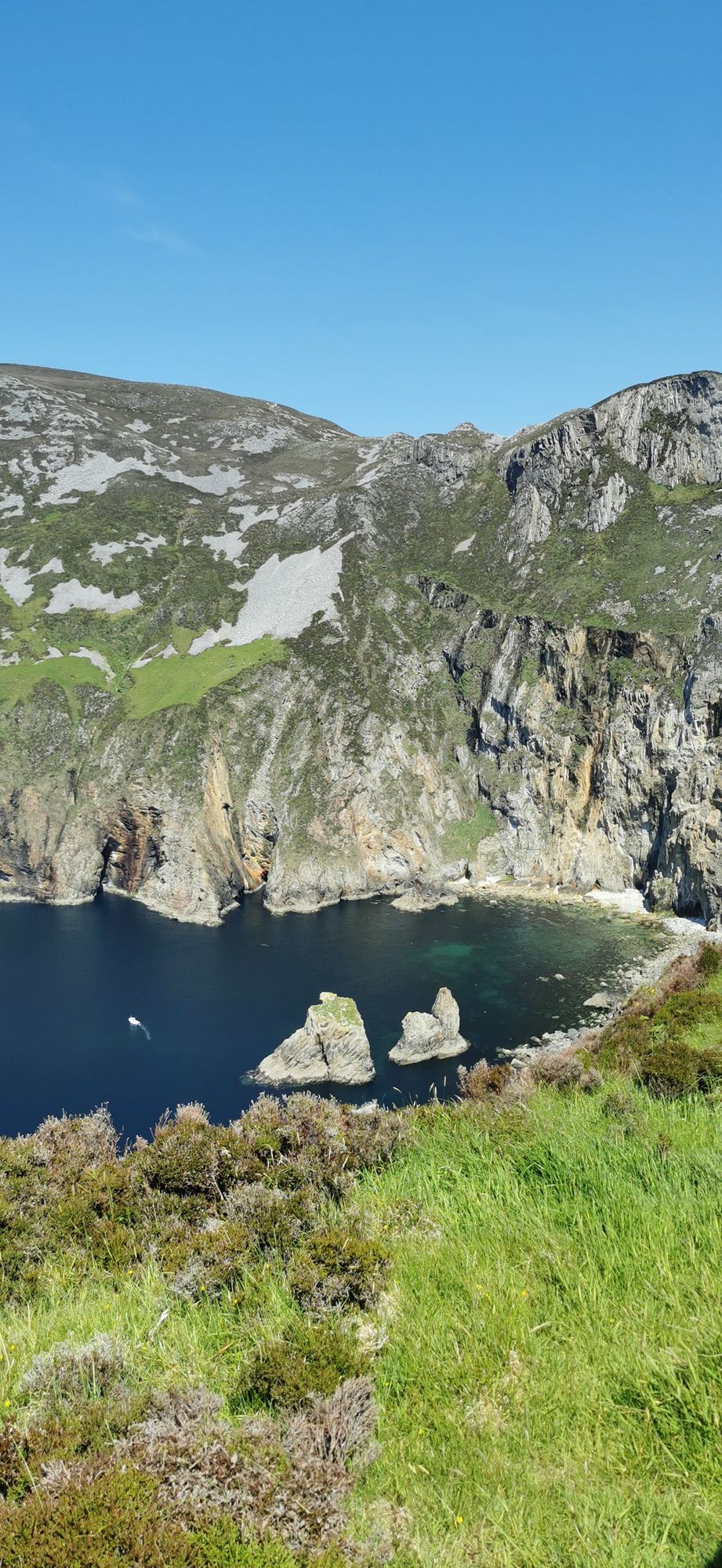
Headland · Co. Donegal
Slieve League
A wall of grey limestone dropping roughly 600 metres into the Atlantic on the Derrybeg Peninsula in southwest Donegal — among the highest sea cliffs in Europe, and only properly seen from the foot of them.
Village · Co. Donegal
The Inishowen district five kilometres south of Buncrana, named for its patron saint Mura — an early Christian monastery, one of the great surviving cross-slabs, the marina and the forested river valley.
Fahan is a district of Inishowen in the north of County Donegal, five kilometres south of Buncrana, on the eastern shore of Lough Swilly. In Irish it is named after its patron saint, Saint Mura, first abbot of Fahan, who founded an early Christian monastery here. The district is the kind of place that has a story older than the town that grew around it: the monastery, the cross-slab, the river and the forest all sit inside the same short drive, and the lough is at the end of it.
The thing the district is best known for is the Fahan cross-slab, one of the most important surviving examples of early Irish ecclesiastical art, now in the National Museum of Ireland. It came from the old monastery, and the story of it — what it depicts, what it took to make it, and how it got from the village to the museum — is the longest thread in the district’s history. The village is where it was made, and that is enough of a reason to stop.
The Fahan river runs from the hills down to the lough, and the district’s modern life sits at the junction of the two: the marina at the head of the lough, the forested valley of the river, and the beaches along the shore. It is the easy end of Inishowen — the lough on one side, the forest on the other, and the village in between — and the drive from Buncrana is ten minutes.
Allow a morning: the village, the river walk and the marina. Pair it with Buncrana and the lough for a full day from the same base.
Where to stay
Stay in Buncrana and the Fahan is a ten-minute drive, not a detour.
See current availability for your dates. Availability and prices come from the accommodation provider, not from us.
A wall of grey limestone dropping roughly 600 metres into the Atlantic on the Derrybeg Peninsula in southwest Donegal — among the highest sea cliffs in Europe, and only properly seen from the foot of them.
A large, remote mountain and glen country in southwest Donegal, centred on Derryveagh National Park — one of the wildest areas of lowland and mountain on the west coast.
The northwestern tip of mainland Ireland, where the Wild Atlantic Way starts — a lighthouse, a tenth-century cross, and the widest view of two seas you will get on this coast.